Tell us about the job
Takes about a minute. No obligation.
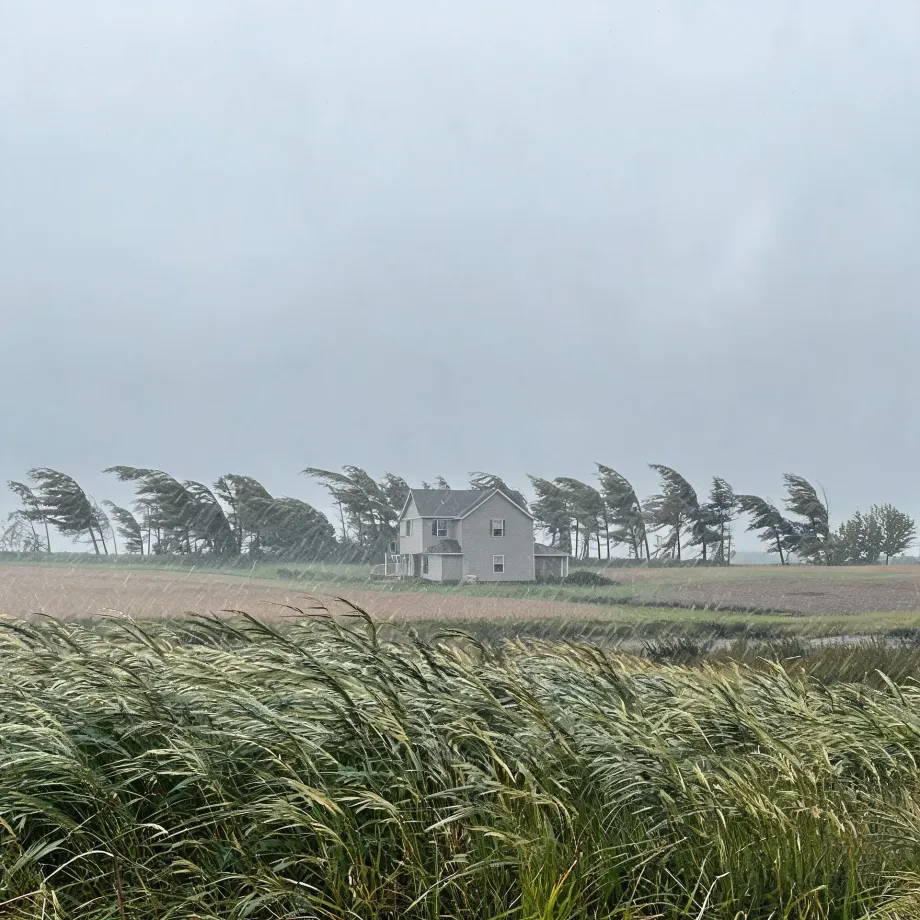
A contractor quoting a central AC install in Hubbard County has to account for what the local climate actually demands before settling on equipment size or installation specs. 175 severe weather events were recorded in Hubbard County, Minnesota between 2015 and 2024. At that rate, severe weather is a standing condition of operating here, and a system sized for average load rather than local load will be underbuilt for what it regularly faces. That gap shows up in run times, in how hard the compressor works, and eventually in how long the equipment lasts. A contractor who knows this area sizes to what the weather here asks of a system, not to what a spec sheet assumes.
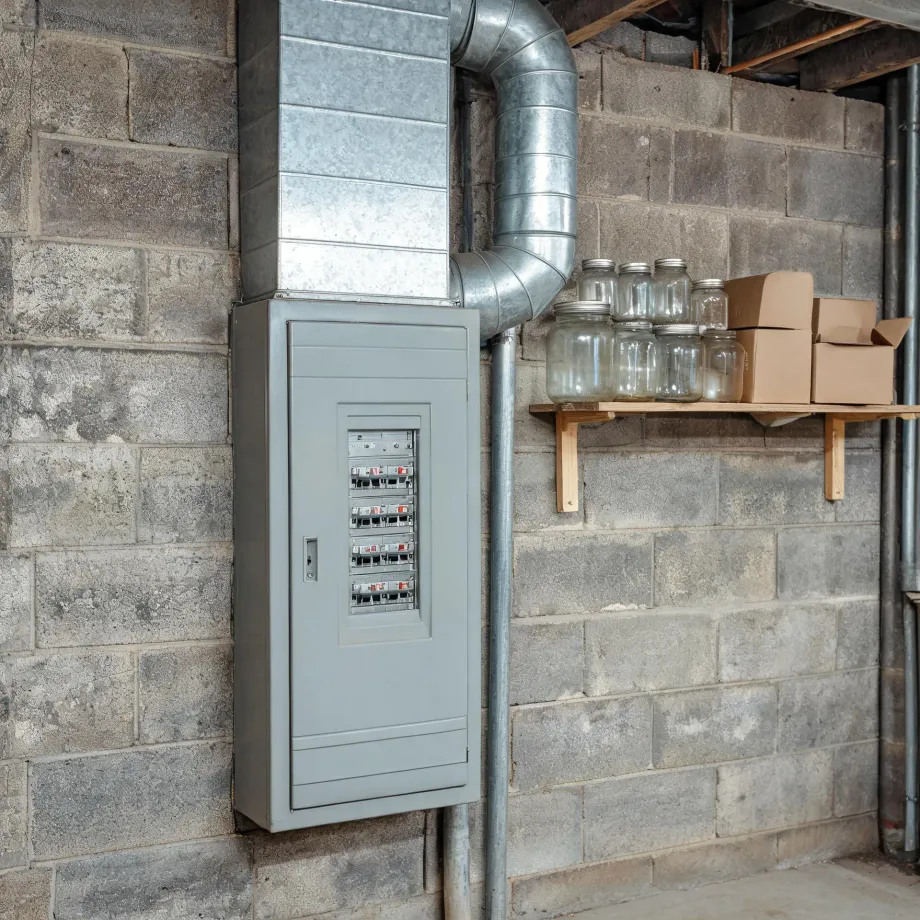
Ductwork laid in for a furnace does not automatically carry a central cooling system. The paths, the sizing, and the return placement were built around a different load, and what a contractor finds when they open up those runs is what sets the real scope of the job. Half the homes in Hubbard County, Minnesota were built in 1985 or earlier (2020-2024 ACS 5-year). That history lands squarely on the installation: a contractor has to assess what is already in the walls before the new unit can be quoted or placed, because the duct system is where the job either works or has to be rebuilt.
What Gets Installed With a New Central AC
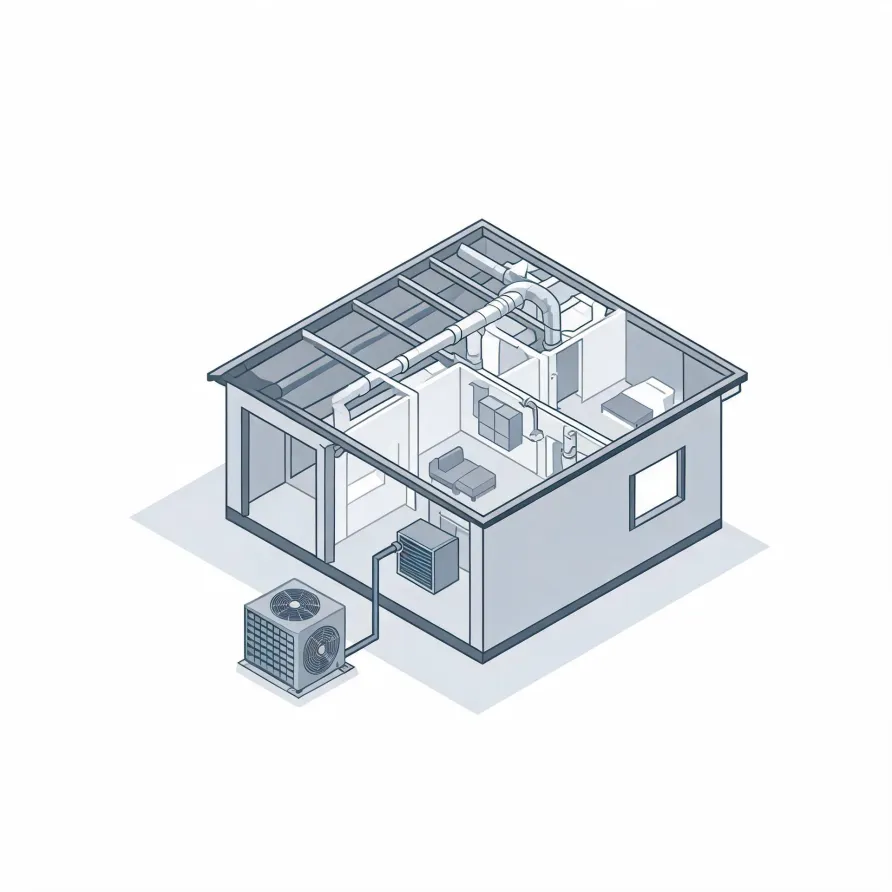
The outdoor condenser unit sits outside the house, usually on a concrete pad at ground level, and holds the compressor and condenser coil. Inside the home, the air handler or furnace-based indoor coil sits in a utility space, basement, or attic and works with the outdoor unit to condition air before it moves through the house.
The refrigerant line set runs between the two units, carrying refrigerant through insulated copper tubing that a contractor routes along the exterior or through interior walls. The thermostat goes on an interior wall and is what the homeowner uses to set and control temperature.
The drawing shows a typical layout, and a licensed contractor determines what applies to this specific house.
Find a contractor in Hubbard CountyHubbard County, by the numbers
175 severe weather events were recorded in Hubbard County, Minnesota between 2015 and 2024.
NOAA National Centers for Environmental Information, Storm Events Database, bulk CSV export, events 2015-01-01 through 2024-12-31.Half the homes in Hubbard County, Minnesota were built in 1985 or earlier (2020-2024 ACS 5-year).
U.S. Census Bureau, 2020-2024 American Community Survey 5-Year EstimatesHubbard County, Minnesota holds 14,765 housing units (2020-2024 ACS 5-year).
U.S. Census Bureau, 2020-2024 American Community Survey 5-Year EstimatesOwners occupy 83.1% of the occupied homes in Hubbard County, Minnesota (2020-2024 ACS 5-year).
U.S. Census Bureau, 2020-2024 American Community Survey 5-Year EstimatesCodes & Standards Behind Central AC Installation in Hubbard County, Minnesota10 sourced rules and standards
What the Installation Actually Looks Like
Split-system central air conditioners rated below 45,000 Btu/h manufactured on or after January 1, 2023 must meet a federal minimum of 13.4 SEER2.
Split-system central air conditioners rated at or above 45,000 Btu/h manufactured on or after January 1, 2023 must meet a federal minimum of 13.4 SEER2.
Split-system central air conditioners manufactured between January 1, 2015 and December 31, 2022 had to meet 13 SEER, the metric that preceded SEER2.
Single-package central air conditioners manufactured on or after January 1, 2023 must meet a federal minimum of 13.4 SEER2.
Space-constrained central air conditioners manufactured on or after January 1, 2023 must meet a federal minimum of 11.7 SEER2.
Federal efficiency standards for split-system central air conditioners and heat pumps are set on each certified combination of outdoor unit and indoor coil rather than on the outdoor unit alone.
Residential and light commercial air conditioning and heat pump systems assembled in the field, including mini-splits and unitary systems, may not be installed on or after January 1, 2025 using a refrigerant with a global warming potential above 700.
A field-assembled system whose specified components were all manufactured or imported before January 1, 2025 carries no installation compliance date under the refrigerant restrictions and may still be installed.
Licensing and Legal Requirements in Hubbard County, Minnesota
Minnesota defines a mechanical contractor as a business that installs, repairs or maintains heating, ventilating, cooling or refrigeration systems — the definition that carries the exemption from the residential contractor licence.
Minnesota's residential contractor licence does not reach HVAC work: the licensing section carries its own exemption list, and a mechanical contractor is exempt from the licence requirement by name.
Severe Weather Events in Hubbard County
What the weather does to a building over time is part of what determines how hard its cooling system has to work. A central AC installation sized and built for local conditions holds up differently than one that was not.
175 severe weather events, 2015–2024. Source: NOAA National Centers for Environmental Information, Storm Events Database.